SUSTAINABLE
GLOBAL GARDENS
TROPICAL TREE PLANTING & CONSERVATION
SGG is a poverty and hunger alleviation charity and most of this page concerns our tropical tree planting in East & Southern Africa. However, as a Rotarian Paul Keeley has become involved in ESRAG RGBI and its Heart4Trees tree planting programme. The Heart4Trees report below may be of interest to Rotarians wishing to plant in the UK or to supplementing their international projects with a tree planting element
EVOLUTION OF TREE PROJECTS
Sustainable Global Gardens began planting trees in Tanzania in 2007. Our earliest efforts were on a small scale with 4,500 planted in the grounds of Soni Seminary in the Usambaras and about 900 planted around Mengwe village, Rombo District on the eastern slopes of Kilimanjaro. There are many reasons for planting trees. At Soni the planted trees provide protection against soil erosion on steep slopes as well as a source of future income & fuelwood. At Mengwe the first focus was on planting valuable indigenous species e.g. Melicia excelsa [Mvule ]

Students at Soni Seminary receive trees for planting in school grounds. Most of these were Grevillea robusta, a multi-purpose tree suitable for protection against soil erosion.The trees were planted on a very steep slope where the soil had no cover.

Some early planting was to promote indigenous species. This was the first Mvule [Milicia excelsa] which SGG helped plant in Rombo District.
Planting on Kilimanjaro and in West Kenya established the advantages of agroforestry for small scale farmers where trees can provide fruits for improving nutrition, fuel wood, fodder, shade and a supplementary income while maintaining good soil conditions on the farm. Many of our Rotary partners in Tanzania were concerned with improving education and conditions in schools so planting on school grounds accounts for much of our tree planting there in 2018.

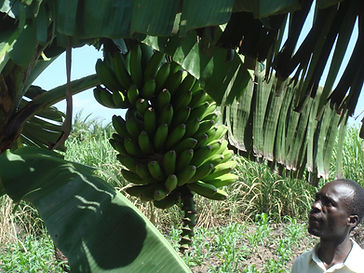

Although tree-planting started in Tanzania, Busia County in West Kenya has often been the location of most SGG tree activity. Soon after SGG had started the feeding programme for 500 orphans +/or vulnerable children in Busia we were asked by guardians how could they find money to pay for the child's education. the solution was 'Trees for School Fees'. At the time eucalyptus were the favourite species because of a good local market and the rapidity of growth. Here [see two photos above] is the same tree & owner photographed in 2009 and 2011. Thus, a farmer could gain a good income from a woodlot within 5 years of planting. More recently Grevillea robusta has become the preferred species. Another major innovation occurred around 2010. Maendeleo Mashinani Organisation volunteer, Philip Namulundu [see left] encouraged SGG to plant bananas. We rapidly realised that bananas can produce a revenue 4-5 times the initial investment within two years. Since 2014 Busia has usually been the major location for SGG-funded tree-planting.

A partnership between SGG and the Rotary Club of Mkuu Rombo enabled the latter to organise a tree planting competition for 25 schools in Rombo District Tanzania in 2012. In 2016 SGG undertook the counting of trees in school grounds and estimated that 8,500 trees had survived and were growing well in those schools. The winner was Maki School who had planted 1,367 trees despite having very rocky ground [see picture left]. Another winner was Mamsera School who had planted mainly Acrocarpus in their maize field [see picture below left]. Prizes of water collecting tanks were awarded to the 3 best schools and a new competition has now been extended to other schools. Other Rotary Clubs had slightly different strategies. Machame Rotary Club wanted to promote Tephrosia vogelii as a natural pesticide and Moringa olifeira as a cash crop of high nutritional value. Within their nursery they also had 1500 Avocado seedlings [see picture below].
Read more...


During the Rotary year 2017-18 RI President Ian Riseley challenged every Rotarian in the world to plant at least one tree. Rotarian Paul Keeley of Newcastle Gosforth Rotary Club in District 1030, UK responded to this challenge by engaging 13 Tanzanian Rotary Clubs and several NGOs in Kenya on behalf of 44 Rotary clubs who donated to this tropical tree planting scheme. By early May 2018 Paul had recorded 41,475 trees which were planted in Busia, West Kenya or North East Tanzania. [see below for report] This project engaged several hundred farmers and thousands of school children all working to improve their farms, school grounds and local environment. Tanzanian & Kenyan tree-planting partners continued planting after 2018 despite all the difficulties of covid. During the 2019-2022 period those farmers accounted for a further 191,118 trees. [see below for report] After the success of this first Tropical Tree-Planting & Conservation [TTP&C] project, SGG is now looking for more Charitable Trusts, other institutions & individuals who will sponsor the current TTP&C project which plans to establish 300,000 healthy trees by 2028.
Recent progress in Kenya

Siritanyi group have been partners with SGG since 2008, so by 2023 when this photo was taken this member had a large stock of mature trees.
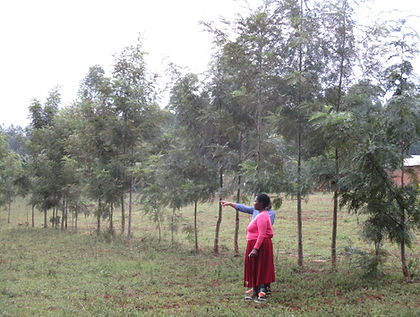

The FOCUSSA group have been founder members of Maendeleo Mashinani Organisation & partners of SGG for more than 15 years. Not only do they have a large stock of trees, but they have also established a small furniture business.
SGG views Kenya as the major location for tree projects. Of the 725 schemes recorded in the 2019-2022 Tropical Tree-Planting & Conservation project, 551 of those were in Kenya accounting for 140,018 of the 202,485 trees recorded. Only 72 schemes were in Tanzania, despite the strong rotarian involvement in the previous 2017-8 plantings. Their total tree-count for 2019-2022 was 32,674. Tree counts in Malawi started only in January 2023, but 26,993 trees were noted. SGG anticipates that this last figure will rise rapidly in the 2023-28 second stage of this tree programme.
Very few Kenya trees have been counted so far in the 2023-2028 Tropical Tree-Planting & Conservation project, but we expect Kenya to continue being the main country for SGG-funded planting. One reason for this is that SGG has expanded support for trees into new areas. One such location is around Kitale where the Friends Meeting has a strong planting programme. This also applies to Birunda Friends group nearby. Here [see above left] one of their members has planted a row of Grevillea robusta along the farm boundary. Elsewhere on this farm there are indigenous species planted [e.g. Elgon teak, Meru oak] and mature trees suitable for carbon capture. Another important community group are Kasiwe Farmers, who are based on Rusinga Island.
,
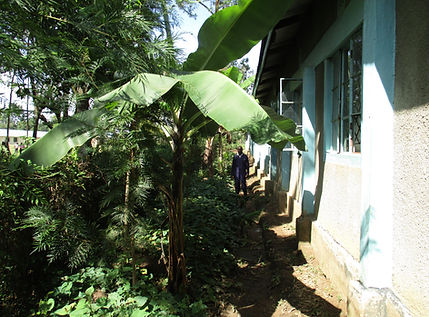
Another significant development is SGG's sponsorship of SCOPE, who specialise in using permaculture methods to transform school grounds into productive horticultural and agroforestry space. Here [see above right] a narrow space at St Denis Libolina School for the Physically Challenged, between a classroom & the school perimeter fence, a space entirely wasted until 2022, has been transformed with a double row of Grevillea robusta as well as bananas and vegetables to boost the school's own food production.
Recent Progress in Tanzania
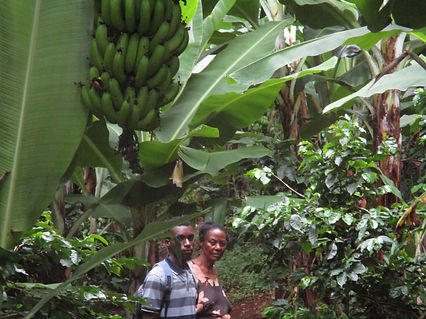

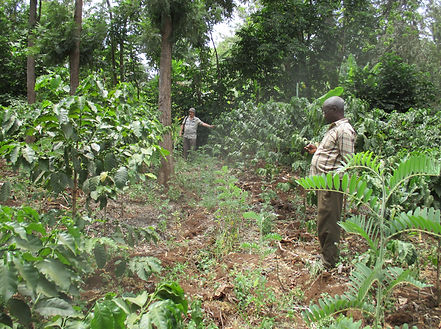
Although North-East Tanzania was the main location for tree-planting in 2017-18, that region fell a long way behind SGG tree-planting elsewhere during the covid years. We now have hopes of Tanzania becoming a major area for SGG activity with the development of a few new partnerships. The most important of these is with Emmanuel Kweka, who works as SGG's tree-counter in Tanzania. Here [see above left] Emmanuel is counting recent plantings within an already crowded Chagga coffee and banana shamba. He is particularly interested in counting the natural pesticide Tephrosia vogelii and also recording large 'carbon capture' trees. Much work in Tanzania has involved tree-planting in extensive school grounds. Here [see above right] is part of a large nursery at Kandoto Science School for Girls. Here Emmanuel counted in August 2025 1208 trees planted since April 2023. Here [see below left] is the area around Vudee and Ndolwa villages in the Pare Mts. Trees are needed here for watershed management to improve local water supply & better control of soil erosion. Avocado trees are also being introduced to establish a cash crop for these inaccessible villages. Emanuel is also involved in the promotion of Tephrosia vogelii as a natural pesticide to replace the use of unhealthy synthetic pesticides. Here [see below] one
of Emmanuel's neighbours in Machame district, Kilimanjaro has planted a row of Tephrosia between his coffee bushes. The Tephrosia is used not just as an inexpensive pesticide but also as a soil improver.

For the last few years SGG has not had sufficient time to make a complete tree count at our many contacts within the country. Thus the SGG records show only that only 32,647 trees were recorded by SGG in the 2019-2023 project. However, we remain optimistic that Tanzania will achieve a planting target of 50,000 to be reached by the end of 2028. Since the appointment of Emmanuel in 2024 a tree count of 14,524 has been recorded. We anticipate that this total will rise rapidly in the next 12 months. The basis of this is that SGG is just beginning to collaborate with other NGOs with similar environmental aspirations working in localities familiar to SGG. Empower Tanzania [see www.empowertz.org for details] is one such example, based in Same where we already have several tree-planting contacts. The Mikuyu Trust, based in Babati, is another new contact [see www.mikuyutanzania.org for details] SGG is also interested in the development of pesticides based on Tephrosia vogelii, so it is likely that we shall record a large number of this particular species in the next two years. Yet another potential new development within SGG's portfolio of projects is "Kisiki Hai" or Farmer Managed Natural Regeneration [FMNR]. This is a technique which has proved very useful for restoring badly degraded rangelands, and Tanzania has very extensive areas with this problem.
For the last three years